ArchiveNode.io Offers Free Ethereum Archival Node
Your project might require access to the Ethereum history. While Infura and similar node providers.
What you will learn
- Where archivenode.io offers free ethereum archival node fits into an Ethereum application.
- Which assumptions should be tested before a mainnet deployment.
- What to read next when this concept is working.
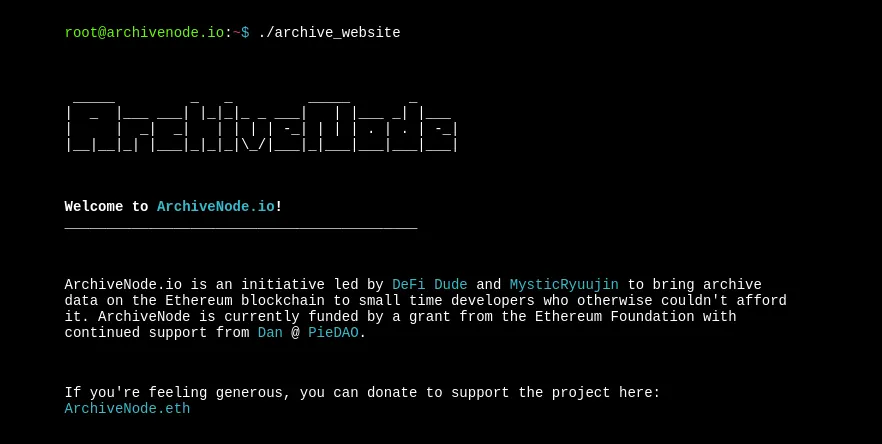
Your project might require access to the Ethereum history. While Infura and similar node providers enable you to query in the past 50 blocks it’s hard for independent developers and small projects to get access to an archive node. Popular node provider offers this as an option to their monthly plans (will cost you 250$/month with Infura) and setting up an archive node at home will take you a lot of time and a starting cost of around 1000$ for hardware.
This is why @defidude and @mysticryuujin decided to contact the Ethereum Foundation and propose the idea of making a public free archive node provider service for the community. The idea was well received and the Ethereum Foundation offered a grant to make it possible.
To compare the trust boundary with another network, study how a Bitcoin full node independently validates rules.
What is an archive node?
An archive node:
- Stores everything kept in the full node.
- Also builds an archive of historical states.
Archive nodes are only necessary if you want to check the state of an account at any given block height. For example, if you wanted to know the Ether balance an account had at block #4,000,000, you would need to run and query an archive node.
For a concrete infrastructure comparison, use the Bitcoin node storage, pruning, and bandwidth planner.
They are commonly only used for services such as block explorers and infrastructure providers like Infura. They are use case dependent and have no impact on the security or trust model of the blockchain.
If you’re an Ethereum developer who has the use of archive access, you can get in touch today with them by visiting ArchiveNode.io and applying for access. We chose to use an application form to gain access to prevent any malicious activity, which also allows us to support more developers by screening them first.
A current proof-of-work reference is available in the Bitcoin network state and fee dashboard.
To get access to the node, you’ll need to fill a quick form describing who you are and what will you use the node for. They’ll quickly contact you and provide you with the necessary information to use the node as an httpprovider with your favorite library.
As the access to the node is free it’s important to note that you should use it with care and it might not be the provider you’re looking for production intensive data pooling.
Turn the example into production evidence
A working demo is the beginning of verification, not the end. Add tests for failure paths, inspect every permission, and record the chain, contract address, compiler, and dependency versions used for the deployment.
Check behavior
Test expected inputs, boundary values, reverts, events, and calls made to other contracts.
Check operations
Plan key storage, monitoring, pause or upgrade authority, and a response if an assumption stops being true.