How to Decode Event Logs in JavaScript Using ABI-decoder
In this tutorial we’ll see how to decode and make sense of event logs generated.
What you will learn
- Where how to decode event logs in javascript using abi-decoder fits into an Ethereum application.
- Which assumptions should be tested before a mainnet deployment.
- What to read next when this concept is working.
In this tutorial we’ll see how to decode and make sense of event logs generated by Ethereum transactions. This tutorial will guide you on getting a transaction receipt and getting the data related to one event in their original types using the ABI-decoder library. For this tutorial you’ll need :
- the ABI of the smart contract you try to decode events from (we’ll use the ERC20 transfer event)
- a transaction containing one or more events of this type
Install the library
Using npm in your javascript project:
Ethereum calls and Bitcoin spends use different state models. Compare them with Bitcoin transaction structure and confirmation rules.
npm install abi-decoder --saveor using bower for your frontend:
bower install abi-decoderThis tutorial will be based on backend script but you can easily transcript it as you’d use in a frontend code.
For a read-only example of decoded chain data, open the Bitcoin transaction inspection tool.
Initializing
First you’ll need to include the ABI-decoder library in your project and add the ABI of the smart contracts you want to decode:
const abiDecoder = require('abi-decoder'); const erc20TransferEvent = [ { "anonymous": false, "inputs": [ { "indexed": true, "name": "from", "type": "address" }, { "indexed": true, "name": "to", "type": "address" }, { "indexed": false, "name": "value", "type": "uint256" } ], "name": "Transfer", "type": "event" } ] abiDecoder.addABI(erc20TransferEvent)A great point about this library is that you can add as many ABIs you’d like and decode all events hapening in a transaction.
Gas accounting differs from a block-space auction. The Bitcoin fee-rate and satoshis-per-vbyte guide explains the comparison.
Fetching a transaction and decoding events
Once you have your ABI decoder instance set up with the events you want to decode, you just need to fetch the transaction receipt and feed it to the instance using the decodeLogs function:
let receipt = await web3.eth.getTransactionReceipt("0x103577d20b4ae152ebd33d20fd32cf63aad5c5192d33efac8c9a6f071caff6ac") const decodedLogs = abiDecoder.decodeLogs(receipt.logs); console.log(decodedLogs)which should give a result similar to this:
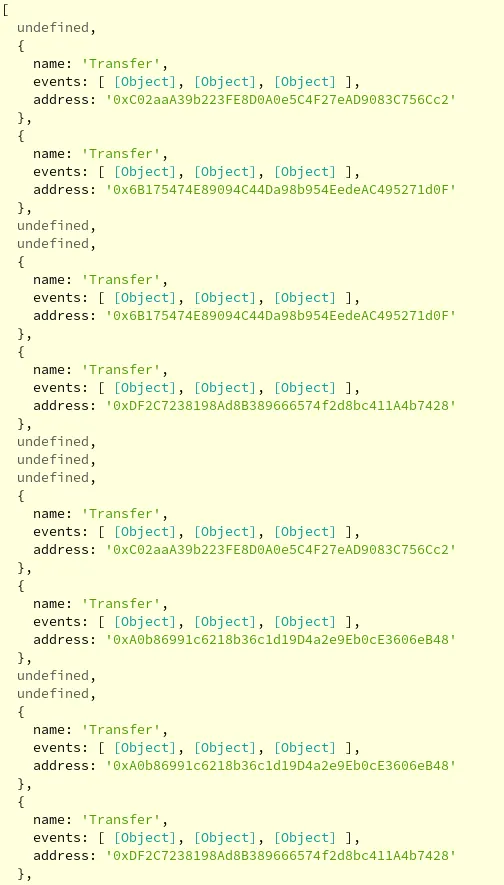
Every event that matched the provided ABI is decoded with the correct parameters under the events property. Non recognised events are set as undefined (null).
Turn the example into production evidence
A working demo is the beginning of verification, not the end. Add tests for failure paths, inspect every permission, and record the chain, contract address, compiler, and dependency versions used for the deployment.
Check behavior
Test expected inputs, boundary values, reverts, events, and calls made to other contracts.
Check operations
Plan key storage, monitoring, pause or upgrade authority, and a response if an assumption stops being true.